---
title: Comparing Numbers
---
# #18. Comparing Numbers
Note
This is a web-version of a tutorial chapter embedded right into the XOD IDE.
To get a better learning experience we recommend to install the
desktop IDE or start the
browser-based IDE, and you’ll see the same tutorial there.
Now, let's learn how to work with conditionals in XOD.
We will measure a lightness level, and if the values exceed or are below the
threshold, we will turn an LED on or off.
XOD has `greater`-than and `less`-than nodes to do simple
mathematical comparisons. They are in `xod/core`.
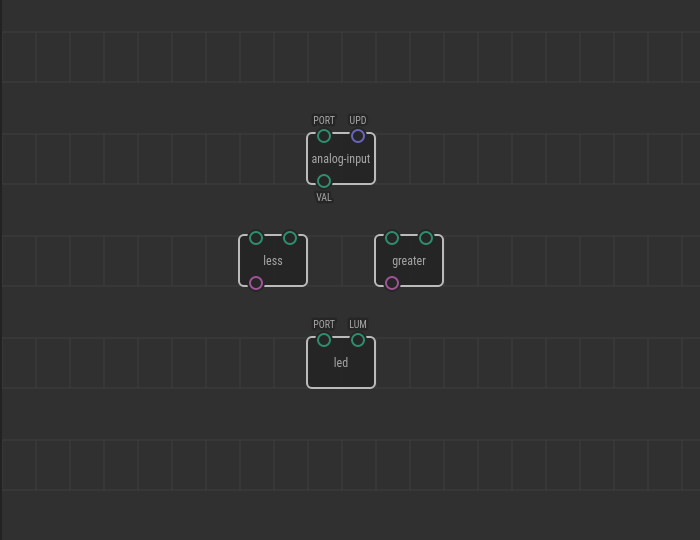
The left `IN1` and right `IN2` pins receive numbers to compare, and the output
`OUT` pin returns the comparison result expressed as a boolean value (true or
false).
## Test circuit
Note
The circuit is the same as for the previous lesson.

[↓ Download as a Fritzing project](./circuit.fzz)
## How-to
* Place a `xod/core/less` (or `greater`) node to trigger an action when
a measured parameter goes under (or over) a threshold value.
* Use the left pin to link the value measured.
* Set the threshold as the right pin value.
* In cases where figuring out the proper threshold is tricky use a value
from a potentiometer to adjust it dynamically.

In the example shown, if the `analog-sensor` node (our photoresistor) returns a
value greater than the threshold, the `greater` node will set the `OUT` pin to
`true`, and the LED will turn on.
[Next lesson →](../19-if-else/)