 98481c5145
* Refactor GitHub Actions workflows for build, documentation, and linting

- Consolidated build logic into reusable workflows (`task-build.yml` and `task-docs.yml`) to reduce duplication across multiple workflows.
- Introduced `environments.json` to centralize the list of PlatformIO build environments, improving maintainability and clarity.
- Updated `build.yml` and `build_and_docs_to_dev.yml` to utilize the new reusable workflows and environment definitions.
- Enhanced `release.yml` to streamline the release process and integrate documentation generation.
- Created reusable linting workflow (`task-lint.yml`) to standardize code formatting checks across the repository.
- Simplified manual documentation workflow by leveraging the new reusable documentation workflow.
- Improved artifact management and retention policies across workflows.
- Updated dependencies and versions in workflows to ensure compatibility and performance.

CI/CD pipeline agnostic of Workflow Engine and integrated on github actions

- Implemented ci.sh for orchestrating the complete build pipeline.
- Created ci_00_config.sh for centralized configuration of build scripts.
- Created ci_build_firmware.sh for building firmware for specified PlatformIO environments.
- Created ci_prepare_artifacts.sh for preparing firmware artifacts for upload or deployment.
- Created ci_set_version.sh for updating version tags in firmware configuration files.
- Created ci_build.sh to orchestrate the complete build pipeline.
- Created ci_qa.sh for code linting and formatting checks using clang-format.
- Created ci_site.sh for building and deploying VuePress documentation with version management.
- Implemented checks for required tools and dependencies in the new scripts.
- Improved internal scripts for better error handling and logging.

UPDATE the web installer manifest generation and update documentation structure
- Enhanced ci_list-env.sh to list environments from a JSON file.
- Replaced  common_wu.py and gen_wu.py scripts with new npm scripts for site generation and previewing on docsgen/gen_wu.js
- Replaced  generate_board_docs.py with docsgen/generated_board_docs.js
- Added new npm scripts for integration of site generation on build phase.
- Created preview_site.js to serve locally generated site over HTTPS with improved error handling.
- Added new CI environments for CI builds in environments.json.
- Deleted lint.yml as part of workflow cleanup.
- Enhanced task-build.yml to include linting as a job and added support for specifying PlatformIO version.
- Improved task-docs.yml to handle versioning more effectively and added clean option.

Enhance documentation
- ADD CLEAR Mark of development version of site
- Updated README.md to include detailed workflow dependencies and relationships using mermaid diagrams.
- Improved development.md with a quick checklist for contributors and clarified the code style guide.
- Enhanced quick_start.md with tips for contributors and streamlined the workflow explanation.

LINT FIX
- Refined User_config.h for better formatting consistency.
- Adjusted blufi.cpp and gatewayBT.cpp for improved code readability and consistency in formatting.
- Updated gatewaySERIAL.cpp and mqttDiscovery.cpp to enhance logging error messages.
- Improved sensorDS1820.cpp for better logging of device information.

Add security scan workflows for vulnerability detection

Add SBOM generation and upload to release workflow; update security scan summary handling

Add shellcheck suppor + FIX shellcheck warning

Enhance documentation for CI/CD scripts and workflows, adding details for security scanning and SBOM generation processes

Fix formatting and alignment in BLE connection handling

Reviewed the full web board presentation and the ESP32 web upload. The project uses a modern pattern where data is divided from the presentation layer.

- Removed the `generate_board_docs` script.
- Updated the `gen_wu` script in order to generate `boards-info.json`: the fail that containe all information about the configuration
- Created and isolate the file `boards-info.js` to streamline the parsing of PlatformIO dependencies, modules, environments and improve the handling of library information.
- Introduced vuepress component `BoardEnvironmentTable.vue` that render `boards-info.json` as UI card component
- Introduced vuepress component `FlashEnvironmentSelector.vue` that render a selectred environment from  `boards-info.json` and provide esp-web-upload feature on it
- Introduced a new board page `board-selector.md` for improved firmware selection.
- Updated `web-install.md` to enhance the firmware upload process, including a new board environment table.
- Enhanced custom descriptions in `environments.ini` to include HTML links for better user guidance and board image link

Add CC1101 initialization improvements and logging enhancements
Add installation step for PlatformIO dependencies in documentation workflow

Remove ci_set_version.sh script and associated versioning functionality

* Fix comment provisined

Fix PlatformIO version input reference in documentation workflow

Remove outdated Squeezelite-ESP32 installer documentation
8.3 KiB
::: warning Development Version This is the edge version of the documentation. It is under active development and may contain bugs, incomplete features, or breaking changes. Use it at your own risk. :::
OpenMQTTGateway aims to unify various technologies and protocols into a single firmware. This reduces the need for multiple physical bridges and streamlines diverse technologies under the widely-used MQTT protocol.

What is an MQTT gateway or bridge ?
MQTT, short for Message Queuing Telemetry Transport, is a lightweight messaging protocol ideal for IoT devices.
An MQTT gateway or bridge plays a pivotal role in the MQTT ecosystem:
- Protocol Translation: It converts non-MQTT protocols (like LoRa or Bluetooth) into MQTT, enabling broader network communication.
- Data Aggregation: Combines data from multiple devices into single messages, optimizing network use.
- Security: Incorporates features like SSL/TLS encryption to safeguard data during transmission.
- Device Management: Handles tasks like firmware updates and remote configuration changes.
In essence, an MQTT gateway ensures smooth communication between devices and MQTT brokers, enhancing the efficiency and security of IoT systems.
What OpenMQTTGateway can do ?
OpenMQTTGateway integrates with established technologies, such as 433mhz/315mhz protocols and infrared (IR), allowing you to upgrade and repurpose older devices. Additionally, OMG is compatible with modern technologies like Bluetooth Low Energy (BLE) and LoRa.
To have an overview of the supported PIR, door, water, temperature, smoke sensors, sirens, rings, beacons, switches & weather stations you can take a look to the compatible devices list
You can run OpenMQTTGateway on a wide variety of boards, ESP32, ESP8266, ESP32S3, ESP32C3. BLE to MQTT gateway can also run on Raspberry Pi, Windows or Unix computers thanks to Theengs Gateway.
Using MQTT, you can seamlessly integrate with home automation platforms such as OpenHAB, Home Assistant, and others, or with IoT software like Node-Red.
Use cases
Leveraging OpenMQTTGateway with a controller allows you to:
- Monitor a garden with a Mi Flora BLE sensor and control an irrigation valve depending on the soil moisture,
- Trigger a fan depending on the temperature and humidity thanks to a Mi Jia/LYWSD03MMC BLE sensor,
- Follow your meat temperature when cooking with an Inkbird IBBQ
- Alert yourself by a controller notification if the temperature of a fridge or freezer is too high,
- Detect a beacon/smartwatch so as to trigger a special scenario when you come home,
- Lose weight with the help of a complete log system, video from @Andreas Spiess
- Detect opened door or windows through 433mhz or BLE and alert yourself when leaving
- Detect water leakage or smoke remotely
- Actionate a siren if something is going wrong
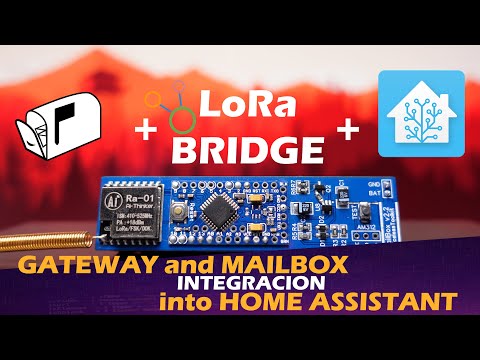
- Detect if your far mailbox has been opened by the postman with LoRa
- Make smart your old TV or AC system through infrared control
- Monitor vehicle tire pressure
The limit is your imagination 😀
Functions
Under the hood, OpenMQTTGateway offers features such as:
- Deduplication
- Simple and lite API
- Strong integrations with libraries used
- Signal forward/repeat
- Wifi web portal onboarding
- Web portal configuration
- Whitelist & Blacklist management
- Secure connections
- Over the air updates
- Local or cloud, your choice
Using OpenMQTTGateway ?
Support open-source development through sponsorship and gain exclusive access to our private forum. Your questions, issues, and feature requests will receive priority attention, plus you'll gain insider access to our roadmap.
Products powered by OpenMQTTGateway
Theengs Bridge, BLE gateway with external antenna
Theengs bridge is a powerfull BLE to MQTT gateway for over 100 sensors. Equipped with an Ethernet port, and external antenna, ensuring an enhanced range for your BLE sensors. It supports also WiFi connectivity.

Theengs Plug, BLE gateway and Smart Plug
Theengs plug brings the following features:
- BLE to MQTT gateway, tens of Bluetooth devices supported thanks to Theengs Decoder library. The plug uses an ESP32 acting as a BLE to Wifi gateway to scan, decode and forward the data of the nearby sensors,
- Smart plug that can be controlled remotely,
- Energy consumption monitoring,
- Device tracker,
- Presence detection (beta),
- Local connectivity first.

Support the project by purchasing the Theengs bridge or the Theengs plug
Media
- Hackaday - ARDUINO LIBRARY BRINGS RTL_433 TO THE ESP32
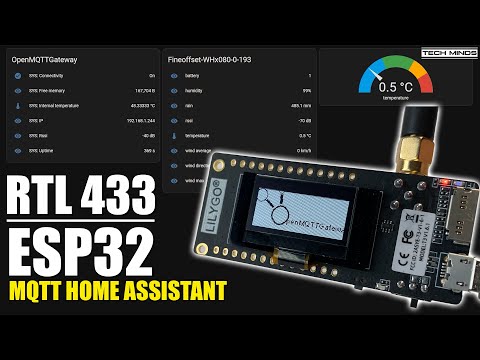
- CNX Software - 433 MHz is not dead! Using an ESP32 board with LoRa module to talk to 433 MHz sensors
- RTL_433 PORTED TO ESP32 MICROCONTROLLERS WITH CC1101 OR SX127X TRANSCEIVER CHIPS
- Using low-cost wireless sensors in the unlicensed bands
- SMART PLUG ESP32 OPENMQTTGATEWAY SERVING AS AN BLE MQTT GATEWAY AND A POWER METER
Theengs Plug

433Mhz and BLE

BLE
433Mhz
LORA
::: warning Note The material and information contained in this documentation is for general information purposes only. You should not rely upon the material or information on this documentation as a basis for making any business, legal or any other decisions. There is no warranty given on this documentation content. If you decide to follow the information and materials given it is at your own risk. I will not be liable for any false, inaccurate, inappropriate or incomplete information presented on this website. :::